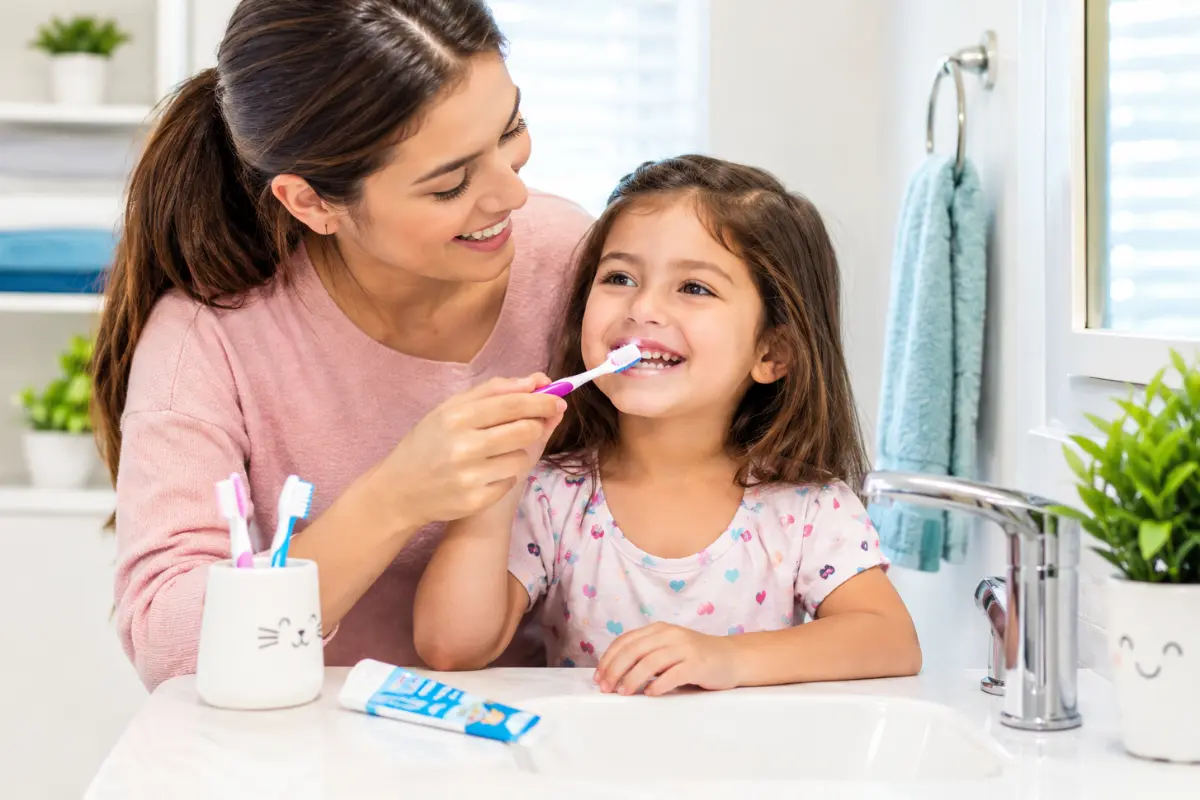
Choosing the Best Toothpaste for Kids can be challenging for parents, especially with so many options available. A healthy smile begins long before a child loses their first baby tooth. Choosing the right toothpaste is an important part of supporting your child’s oral health. Not every toothpaste is suitable for every age or dental need.
Children’s teeth are more susceptible to tooth decay because their enamel is thinner than that of adults. Young children are also more likely to swallow toothpaste while learning to brush, making both ingredient selection and correct toothpaste use important.
This guide explains what parents should know when choosing the best toothpaste for kids, including when children should start using toothpaste, how much to use at different ages, which ingredients to look for, what to be cautious about, and how fluoride compares with hydroxyapatite toothpaste.
Why Choosing the Best Toothpaste for Kids Matters
Choosing the Best Toothpaste for Kids is an important part of protecting your child’s developing teeth and supporting cavity prevention from an early age.
Since young children may swallow toothpaste while learning to brush, parents should choose a product that is appropriate for the child’s age and use the recommended amount.
An age-appropriate toothpaste with suitable ingredients can help support enamel health, cavity prevention, and healthy oral hygiene habits.
When Should Babies and Kids Start Using Toothpaste?
Many parents wonder when it is safe to introduce toothpaste and whether babies need it when they have only one or two teeth.
Good oral hygiene starts early, but the type and amount of toothpaste should change as your child grows.
The American Dental Association (ADA) provides detailed guidance on children’s toothpaste use, including age-appropriate toothpaste amounts and fluoride recommendations.
Before the First Tooth Appears
Even before your baby’s first tooth erupts, gently cleaning the gums can help keep the mouth clean.
You don’t need toothpaste at this stage.
Instead, gently clean your baby’s gums once or twice a day using:
- A clean, damp, soft cloth
- Moist gauze
- A silicone finger brush designed for infants
This simple routine can help your baby become familiar with oral care before toothbrushing begins.
When the First Tooth Appears
As soon as the first tooth erupts, begin brushing with a soft-bristled infant toothbrush and an appropriate amount of fluoride toothpaste.
At this stage:
- Brush twice a day.
- Use a soft baby toothbrush.
- Use a rice-grain-sized smear of toothpaste.
- Supervise brushing.
Because babies may swallow toothpaste, parents should control the amount used and avoid allowing the child to suck or chew on the toothbrush.
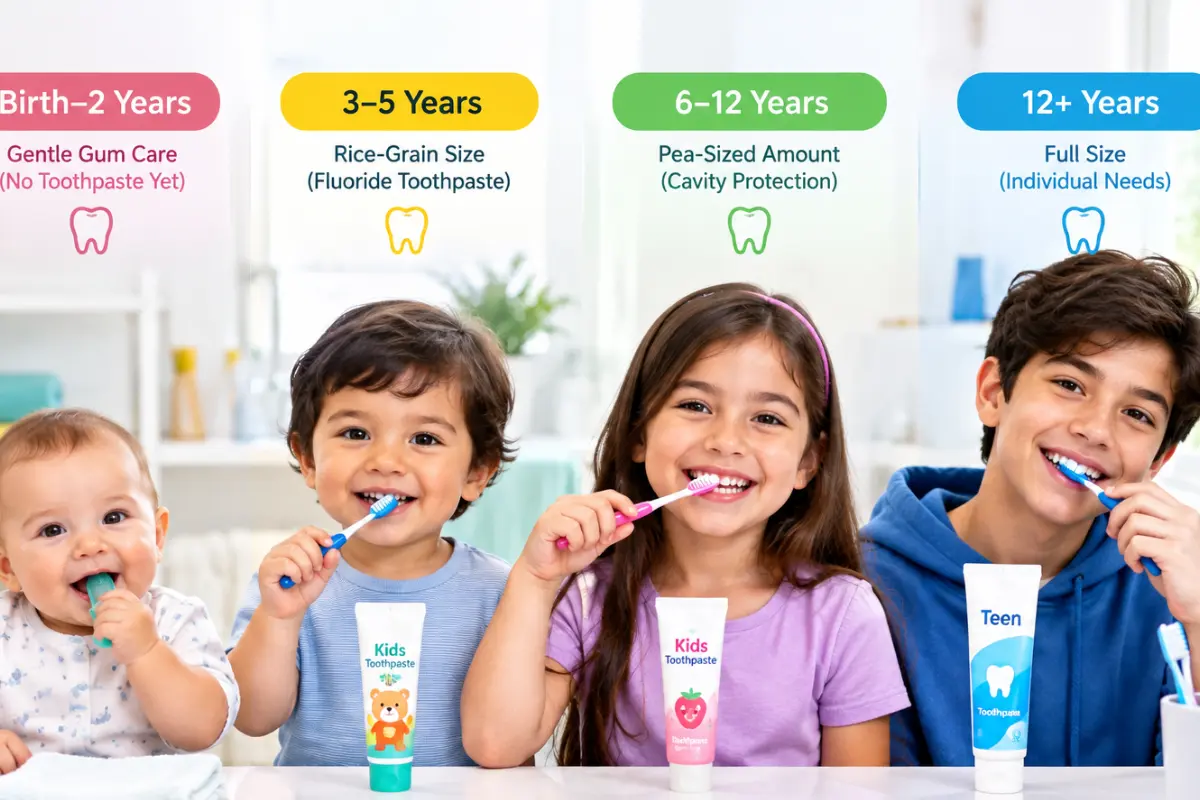
Toddlers (Ages 1–3 Years)
Toddlers are active and energetic, but they have not yet mastered brushing or spitting consistently.
Parents should continue doing most of the brushing while encouraging their child to participate.
At this age:
- Brush twice daily.
- Continue using a rice-grain-sized amount of toothpaste.
- Teach your child to spit gently.
- Keep toothpaste out of reach when it is not being used.
Creating a fun routine, such as brushing together or using a favorite song, can make brushing easier.
Preschoolers (Ages 3–6 Years)
Children gradually become better at brushing and learning to spit out toothpaste.
At this stage, use a pea-sized amount of toothpaste.
However, supervision remains important because many preschoolers still:
- Miss hard-to-reach areas.
- Brush too quickly.
- Swallow some toothpaste.
- Use more toothpaste than necessary.
Parents should continue teaching proper brushing techniques until the child can brush effectively and consistently.
School-Age Children (6–12 Years)
As baby teeth are replaced by permanent teeth, protecting the teeth from cavities becomes increasingly important.
Encourage children to:
- Brush for two full minutes.
- Use the appropriate amount of toothpaste.
- Clean every tooth surface.
- Floss when teeth touch.
- Replace their toothbrush regularly.
Many children enjoy choosing their own toothpaste flavor, which may help make daily brushing more enjoyable.
Teenagers (12 Years and Older)
Teenagers can generally use toothpaste formulated for older children or adults, depending on their dental needs and their dentist’s recommendations.
Depending on their individual needs, they may benefit from toothpaste designed to support:
- Cavity protection
- Sensitive teeth
- Gum health
- Plaque control
- Orthodontic care
Although teenagers can usually brush independently, they should continue maintaining regular brushing, flossing, and dental checkups.
Age-Wise Toothpaste Guide
| Age Group | Toothpaste Recommendation | Amount to Use | Parent Supervision |
|---|---|---|---|
| Birth–first tooth | No toothpaste before teeth erupt | None | Clean gums |
| First tooth–3 years | Age-appropriate fluoride toothpaste | Grain-of-rice-sized smear | Always |
| 3–6 years | Fluoride toothpaste | Pea-sized amount | Yes |
| 6–12 years | Age-appropriate fluoride toothpaste | Follow age-appropriate directions | Recommended |
| 12+ years | Toothpaste appropriate for individual needs | Follow product directions | As needed |
This table gives parents a quick reference, while the sections above provide more detail about each stage.
Fluoride vs. Hydroxyapatite Toothpaste for Kids
One of the most common questions parents ask is whether they should choose fluoride toothpaste or hydroxyapatite toothpaste.
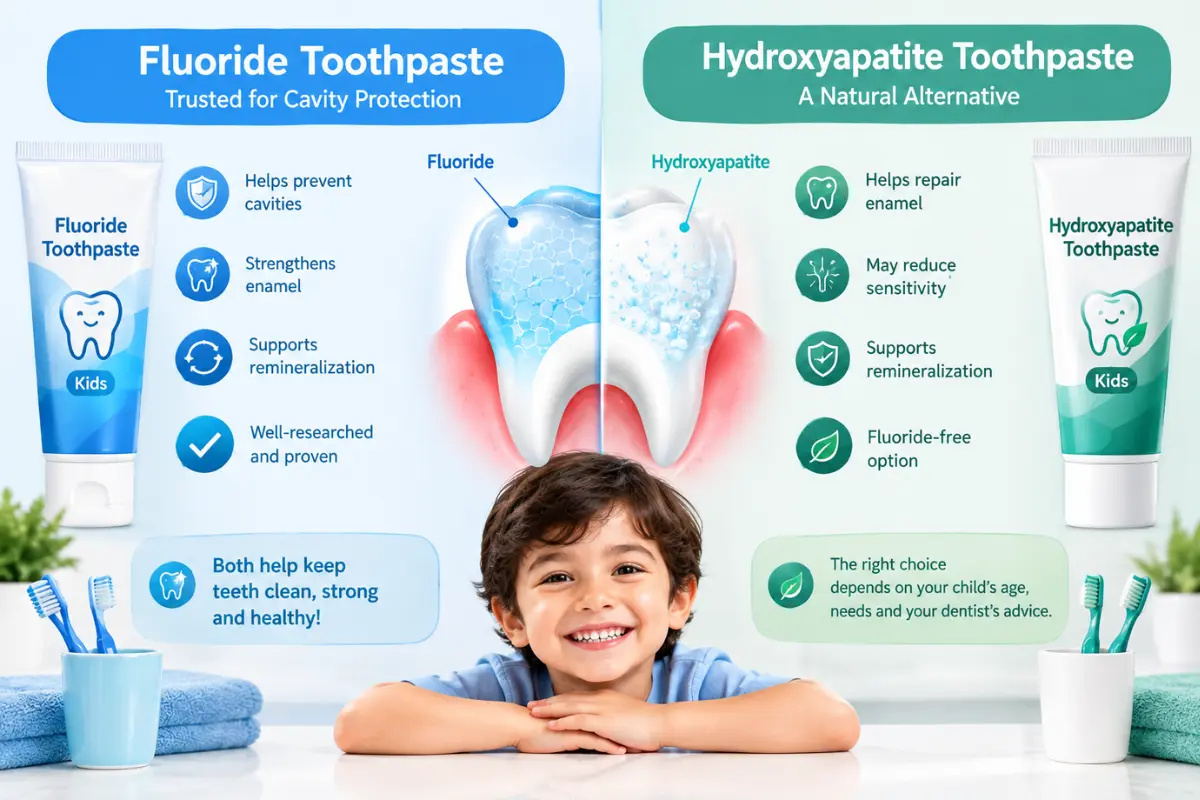
Both are used in oral-care products, but they work differently and may be appropriate in different situations.
The right choice depends on factors such as your child’s age, cavity risk, oral health needs, and professional dental guidance.
What Is Fluoride?
Fluoride is a mineral widely used in toothpaste because of its established role in strengthening enamel and helping prevent tooth decay.
The CDC explains that fluoride helps prevent cavities and recommends age-appropriate amounts of fluoride toothpaste for children.
When used in the appropriate amount, fluoride toothpaste can help:
- Strengthen developing enamel
- Support remineralization of early enamel damage
- Make teeth more resistant to acid attacks
- Reduce the risk of cavities
Benefits of Fluoride Toothpaste
Fluoride toothpaste provides several important benefits, including:
- Cavity protection
- Enamel strengthening
- Support for early enamel repair
- Widely established evidence for cavity prevention
- Easy availability
Is Fluoride Safe for Kids?
Fluoride toothpaste can be used safely by children when the appropriate amount is used.
The key is using the recommended amount for the child’s age and supervising young children during brushing.
Parents should encourage children to spit out excess toothpaste when they are able and avoid allowing them to swallow large amounts.
Using more toothpaste does not provide extra cavity protection.
What Is Hydroxyapatite?
Hydroxyapatite is a mineral that naturally makes up much of tooth enamel and bone. Some toothpastes contain synthetic forms such as nano-hydroxyapatite.
Hydroxyapatite toothpaste is used to support enamel remineralization and has become increasingly popular among families looking for fluoride-free options.
Potential Benefits of Hydroxyapatite Toothpaste
Research on hydroxyapatite toothpaste suggests potential benefits such as:
- Supporting enamel remineralization
- Helping reduce tooth sensitivity
- Supporting tooth-surface repair
- Potentially helping with plaque control
However, the evidence base for hydroxyapatite is not as extensive as the long-established evidence supporting fluoride for cavity prevention.
Fluoride vs. Hydroxyapatite: Side-by-Side Comparison
| Feature | Fluoride Toothpaste | Hydroxyapatite Toothpaste |
|---|---|---|
| Cavity prevention | Strong evidence | Promising evidence |
| Enamel support | Yes | Yes |
| Remineralization | Yes | Yes |
| Sensitivity support | May help | May help |
| Scientific evidence | Extensive | Growing |
| Fluoride-free | No | Yes |
Which Toothpaste Should Parents Choose?
There is no single toothpaste that is perfect for every child.
Consider:
- Your child’s age
- Cavity risk
- Oral hygiene habits
- Individual dental needs
- Your dentist’s advice
For many children, fluoride toothpaste remains an important evidence-based option for cavity prevention. Hydroxyapatite toothpaste may be considered in situations where a fluoride-free option is preferred or recommended.
Rather than choosing toothpaste because of social-media trends or marketing claims, focus on age suitability, ingredients, and your child’s individual oral-health needs.
Don’t Believe Everything You Read Online
Parents should be cautious about strong toothpaste claims made on social media or product packaging.
Be careful of statements such as:
- “Fluoride is always harmful.”
- “Natural toothpaste works the same for every child.”
- “Expensive toothpaste is automatically better.”
- “Baby teeth don’t need cavity protection.”
These statements can oversimplify a complex topic.
When making decisions about your child’s oral health, look for reliable information from qualified dental professionals and recognized health organizations.
Expert Tip
If your child has frequent cavities, sensitive teeth, enamel defects, or other oral-health concerns, ask a dental professional for an individualized recommendation.
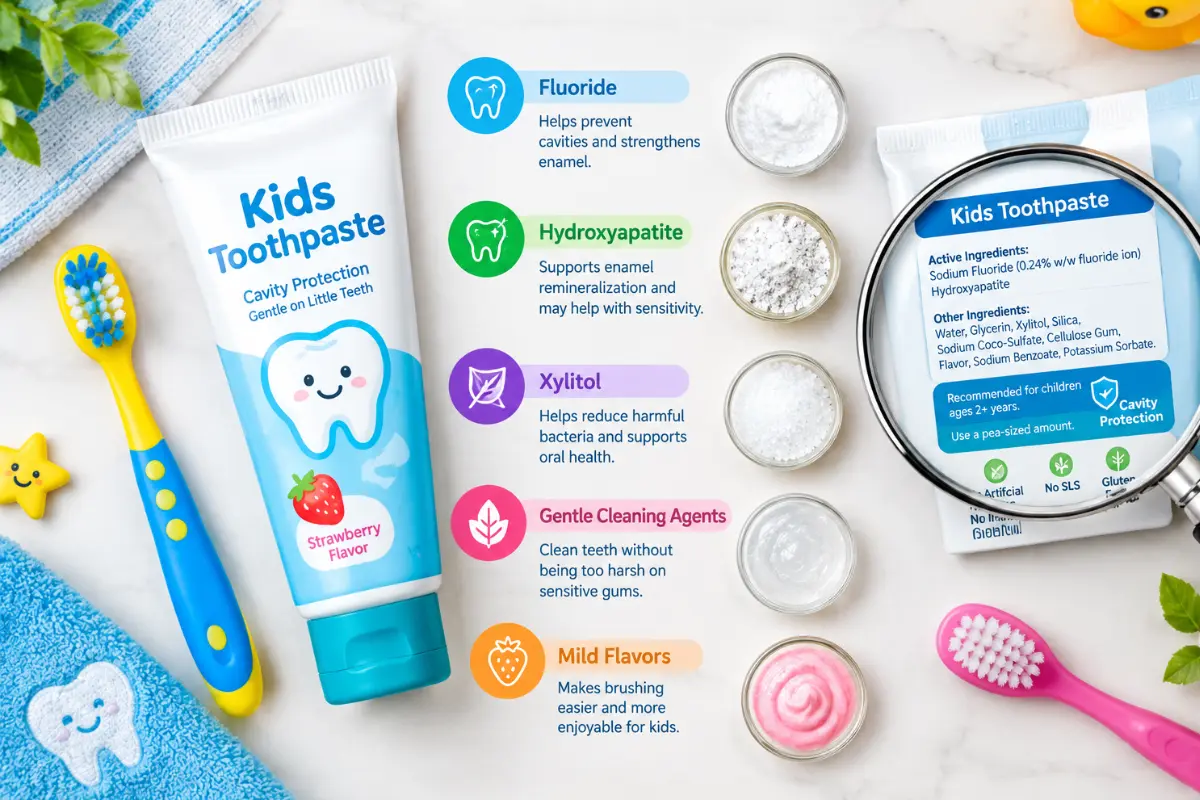
Ingredients to Look For in Kids’ Toothpaste
The ingredient list on a toothpaste tube can seem confusing, but understanding a few key ingredients can help parents make more informed choices.
1. Fluoride
Fluoride is an important ingredient for cavity prevention. It helps strengthen enamel and supports the repair of early enamel damage.
It can be particularly important for children who need daily cavity protection.
2. Hydroxyapatite
Hydroxyapatite is naturally found in tooth enamel and is used in some toothpastes as an alternative active ingredient.
Potential benefits include:
- Supporting enamel remineralization
- Helping with tooth sensitivity
- Supporting the tooth surface
3. Xylitol
Xylitol is a sweetener commonly used in some oral-care products.
Unlike sugar, it does not provide the same food source for cavity-causing bacteria. Some research suggests it may have oral-health benefits when used as part of a complete oral-care routine.
4. Gentle Cleaning Agents
Children do not need highly aggressive polishing products.
Choose toothpaste formulated for children rather than adult whitening formulas with stronger polishing properties.
5. Mild, Child-Friendly Flavors
Flavor does not determine cavity protection, but it can affect whether a child is willing to brush consistently.
Children may prefer flavors such as:
- Strawberry
- Bubblegum
- Watermelon
- Mild fruit flavors
Choose a flavor your child will comfortably use every day while still prioritizing appropriate cavity protection.
Ingredients Parents Should Be Cautious About
Not every ingredient is harmful, but some products or ingredients deserve additional consideration depending on your child’s age and individual needs.
1. Highly Abrasive Whitening Ingredients
Whitening toothpaste is generally unnecessary for young children.
Children’s teeth are naturally different from adult teeth, and whitening does not provide additional cavity protection.
Unless recommended by a dental professional, focus on cavity protection rather than whitening.
2. Strong Mint Flavoring
Some young children find strong mint toothpaste uncomfortable.
If a flavor discourages your child from brushing, choose a milder flavor while still prioritizing appropriate cavity protection.
3. Excessive Artificial Colors
Some children’s toothpastes contain bright colors designed to make the product more appealing.
Parents who prefer simpler formulations may choose products with fewer artificial colorings. However, cavity protection and age suitability should remain the priorities.
4. Sodium Lauryl Sulfate (SLS)
Sodium Lauryl Sulfate, commonly called SLS, is a foaming ingredient found in many toothpastes.
Most children tolerate it, but some people may experience irritation or sensitivity.
If your child repeatedly develops mouth irritation after brushing, discuss the issue with a dental professional.
5. Unproven Marketing Claims
Be cautious of phrases such as:
- “Miracle Formula”
- “Instant Cavity Protection”
- “Chemical-Free”
- “Clinically Perfect”
- “Dentist Secret”
Marketing language alone does not prove that a toothpaste provides better cavity protection.
Instead, consider the active ingredients, age recommendations, directions, and your child’s oral-health needs.
A Quick Label-Reading Checklist
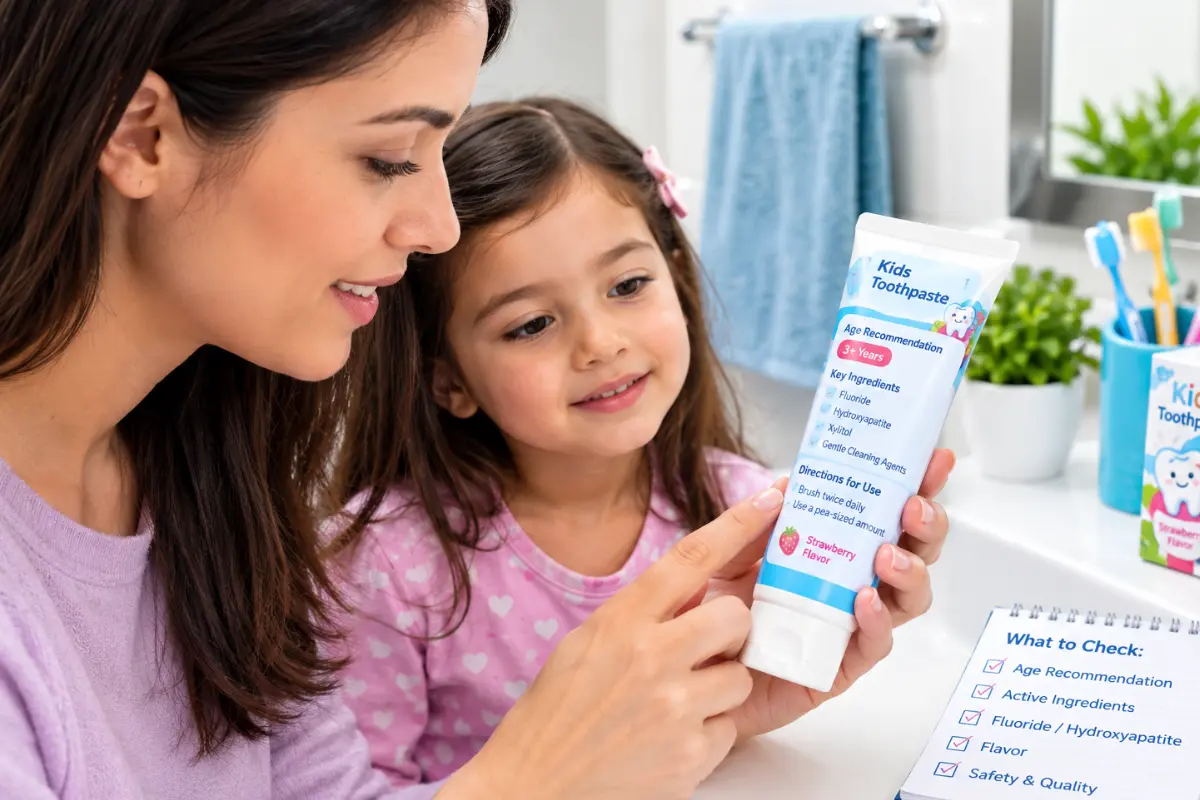
Before buying toothpaste for your child, check the label and ask:
- Is it appropriate for my child’s age?
- Does it contain appropriate ingredients for cavity protection?
- Is it suitable for my child’s dental needs?
- Is the flavor comfortable for my child?
- Is it from a reputable manufacturer?
- Are the directions clear and easy to follow?
A few extra seconds spent reading the label can help you choose a product that fits your child’s needs.
Myth vs. Fact
Myth: Natural toothpaste is always better for children.
Fact:
“Natural” does not automatically mean a toothpaste provides the same level of cavity protection. Parents should consider the active ingredients and their child’s oral-health needs.
Myth: If a toothpaste foams more, it cleans better.
Fact:
Foam does not automatically mean better cleaning or stronger cavity protection.
Myth: The most expensive toothpaste must be the best.
Fact:
Price alone does not determine toothpaste quality. Focus on appropriate ingredients, age suitability, and your child’s needs.
Common Mistakes Parents Make When Choosing Toothpaste for Kids
Many parents want to make good choices for their child’s oral health but can easily be influenced by colorful packaging, flavors, or marketing claims.
1. Choosing Toothpaste Based Only on Flavor
A pleasant flavor can make brushing easier, but flavor should not be the main factor.
Choose toothpaste that:
- Matches your child’s age
- Provides appropriate cavity protection
- Has a flavor your child accepts
- Encourages consistent brushing
2. Using Too Much Toothpaste
Using more toothpaste does not provide additional protection.
Use:
- Under 3 years: A rice-grain-sized smear
- Ages 3–6 years: A pea-sized amount
3. Buying Adult Toothpaste Too Early
Younger children may find adult toothpaste too strong, especially when it has a strong mint flavor or whitening-focused formulation.
Choose a product appropriate for your child’s age and needs.
4. Ignoring the Ingredient List
Do not focus only on the front of the package.
Check:
- Active ingredients
- Age recommendations
- Directions for use
- Safety information
5. Believing Every Marketing Claim
Words such as “natural,” “premium,” “advanced,” “professional,” and “whitening” do not automatically mean better cavity protection.
Look at the actual ingredients and intended use.
6. Letting Young Children Brush Without Supervision
Young children may:
- Miss back teeth
- Brush for only a few seconds
- Swallow toothpaste
- Skip important areas
Parents should supervise until the child can brush effectively and consistently.
7. Choosing Whitening Toothpaste for Children
Most children do not need whitening toothpaste.
Unless recommended by a dental professional, prioritize cavity prevention and enamel protection.
8. Waiting Until Dental Problems Appear
Oral care should begin before dental problems develop.
Regular brushing, appropriate toothpaste, a balanced diet, and dental visits all contribute to preventive oral care.
9. Not Replacing Toothpaste as Children Grow
Children’s oral-care needs can change over time.
Review toothpaste choices based on:
- Age
- Brushing ability
- Permanent teeth eruption
- Orthodontic treatment
- Changes in cavity risk
10. Assuming Toothpaste Alone Is Enough
Toothpaste is only one part of a complete oral-care routine.
Children also need to:
- Brush twice a day
- Floss when teeth touch
- Eat a balanced diet
- Limit sugary snacks and drinks
- Have regular dental checkups
Quick Checklist Before Buying Kids’ Toothpaste
Before placing a toothpaste in your shopping cart, ask:
- Is it suitable for my child’s age?
- Does it provide appropriate cavity protection?
- Will my child comfortably use it every day?
- Is it easy to use correctly?
- Does it fit my child’s specific oral-health needs?
Expert Tip
The best toothpaste is not necessarily the most expensive or most popular product. A suitable toothpaste that your child uses consistently and correctly can be more useful than a product they dislike and refuse to use.
Best Toothpaste for Kids by Age: A Practical Buying Guide
There isn’t one toothpaste that is perfect for every child.
As children grow, their oral-health needs change. Choosing toothpaste according to age, dental needs, and brushing ability can help parents make a more informed choice.
Birth to 2 Years: Building Healthy Habits
Look for:
- An age-appropriate infant toothbrush
- Toothpaste appropriate for infants or toddlers
- A rice-grain-sized smear when brushing teeth
- A comfortable child-friendly flavor
- Clear age recommendations
Parent Tips
- Brush twice a day.
- Supervise brushing.
- Avoid putting your baby to bed with a bottle containing milk or juice.
- Follow your dental professional’s recommendation for the child’s first dental visit.
Ages 3–5: Learning to Brush Independently
At this stage, children become more interested in brushing independently but still need guidance.
Choose toothpaste that offers:
- Appropriate cavity protection
- A flavor your child accepts
- Gentle cleaning
- Clear age-appropriate instructions
Parent Tips
- Use a pea-sized amount.
- Encourage your child to spit out excess toothpaste.
- Brush together to demonstrate proper technique.
- Make brushing part of a consistent daily routine.
Ages 6–12: Protecting Permanent Teeth
As permanent teeth begin to replace baby teeth, maintaining good cavity protection becomes increasingly important.
Look for toothpaste that supports:
- Enamel protection
- Daily cavity prevention
- Plaque control
- Fresh breath
- Gentle cleaning
Parent Tips
- Encourage two-minute brushing.
- Replace toothbrushes regularly.
- Floss when teeth touch.
- Continue checking brushing quality.
Teenagers: Supporting Long-Term Oral Health
Teenagers can usually manage brushing independently, but busy schedules may affect consistency.
Depending on individual needs, toothpaste may support:
- Cavity prevention
- Gum health
- Plaque control
- Tooth sensitivity
- Orthodontic care
Parent Tips
- Encourage brushing twice daily.
- Limit sugary drinks and frequent sugary snacks.
- Continue regular dental checkups.
Choosing Toothpaste Based on Your Child’s Dental Needs
Age is not the only factor that can influence toothpaste choice.
If Your Child Gets Cavities Frequently
Look for toothpaste that supports cavity prevention and enamel protection.
Consistent brushing, a balanced diet, and regular dental visits are also important.
If Your Child Has Sensitive Teeth
Choose products designed for sensitivity only when appropriate for the child’s age.
Persistent tooth sensitivity should be evaluated by a dental professional to identify the underlying cause.
If Your Child Wears Braces
Braces can create additional areas where food and plaque collect.
Focus on careful brushing, plaque removal, and enamel protection. Follow the orthodontist’s recommendations when choosing oral-care products.
If Your Child Dislikes Brushing
Sometimes the biggest challenge is not choosing toothpaste but getting a child to use it consistently.
Consider:
- Letting your child choose between two appropriate flavors
- Using a colorful toothbrush
- Brushing together as a family
- Using a two-minute timer or brushing song
- Praising consistent brushing
Positive reinforcement can make the routine easier.
Toothpaste Buying Comparison Table
| Child’s Age | What to Look For | Parent Reminder |
|---|---|---|
| Birth–2 Years | Infant-friendly product and clear age instructions | Use the recommended amount and supervise |
| 3–5 Years | Cavity protection, child-friendly flavor, age-appropriate formulation | Use a pea-sized amount and guide brushing |
| 6–12 Years | Enamel protection, cavity prevention, plaque control | Encourage two-minute brushing and flossing when teeth touch |
| Teenagers | Cavity prevention, gum health, sensitivity support if needed | Encourage consistent oral care and dental checkups |
Signs It’s Time to Change Your Child’s Toothpaste
As children grow, their oral-care needs can change.
Consider reviewing or changing toothpaste if:
- Your child has outgrown the recommended age range.
- Permanent teeth are erupting.
- A dental professional recommends a different product.
- Your child develops tooth sensitivity.
- Your child consistently refuses to use the current toothpaste.
- Orthodontic treatment begins.
Regularly reviewing your child’s oral-care routine can help ensure that their toothpaste continues to suit their needs.
Expert Tip
Instead of asking, “Which toothpaste is the most popular?”, ask:
“Which toothpaste fits my child’s age, oral-health needs, and daily habits?”
The most useful choice is one your child can use consistently and correctly.
Conclusion
Finding the best toothpaste for kids is about more than choosing the most popular brand or the brightest package on the shelf.
Every child has different oral-health needs that can change as they grow. Parents should consider age, brushing habits, dental development, ingredients, and individual dental needs when choosing toothpaste.
By understanding the available ingredients, using the appropriate amount of toothpaste, encouraging good brushing habits, and seeking professional dental advice when needed, parents can make more informed choices for their child’s oral health.
Remember, toothpaste is only one part of a healthy oral-care routine. Regular brushing and flossing, a balanced diet, dental checkups, and consistent daily habits all work together to support a healthy smile.
Best Toothpaste for Kids: FAQs
- 1. What is the best toothpaste for kids?The best toothpaste for kids should be appropriate for the child's age, support cavity prevention, and fit their individual oral-health needs. A child-friendly flavor can also make consistent brushing easier.
- 2. When should babies start using toothpaste?Parents should begin brushing a baby's teeth as soon as the first tooth appears. Before that, the gums can be gently cleaned with a soft, damp cloth. Once the first tooth erupts, use an appropriate amount of toothpaste and brush twice a day.
- 3. How much toothpaste should children use?The amount depends on age:
- Under 3 years: A smear about the size of a grain of rice
- Ages 3–6 years: A pea-sized amount
- Older children: Follow age-appropriate product directions
- 4. Is fluoride toothpaste safe for children?Fluoride toothpaste can be used safely by children when the appropriate amount is used and young children are supervised during brushing.
- 5. Is fluoride-free toothpaste better for kids?Not necessarily. Some fluoride-free toothpastes contain ingredients such as hydroxyapatite, but fluoride has extensive evidence supporting its role in cavity prevention. The appropriate choice depends on the child's needs and professional dental guidance.
- 6. Can children use adult toothpaste?Older children and teenagers may eventually use toothpaste formulated for adults, depending on their age, brushing ability, and dental needs. Younger children generally benefit from age-appropriate products.
- 7. Should my child use whitening toothpaste?Whitening toothpaste is usually unnecessary for children. Unless recommended by a dental professional, focus on toothpaste that supports cavity prevention and enamel health.
- 8. How often should children brush their teeth?Children should brush their teeth twice a day for about two minutes. Flossing should begin when two teeth touch, and regular dental checkups should be part of their oral-care routine.